
Found 0 record that meets the criteria
More







Are you looking for a product?
Found 0 record that meets the criteria
Release time:2026-10-12
source:首信SHOUXIN
share:
Shouxin Marketing Center
Optimizing the dosing, preparation concentration, and dissolution process of Polyacrylamide (PAM) flocculants is critical for efficient industrial wastewater treatment and sludge dewatering. Improper dosage calculations or incorrect mixing procedures lead to wasted polymer, equipment clogging, and reduced solid-liquid separation performance. Shouxin Advanced Polymer Sciences Co., Ltd. engineers high-grade dry powder and emulsion polyacrylamide formulations while providing technical operational guidance for exact site preparation and dosing.
Polyacrylamide Dosage Calculation Formula: ppm and Per Ton of Dry Solids
Calculating the correct polyacrylamide dosage requires converting required parts per million (ppm) into volumetric or mass dosing rates relative to wastewater flow or total dry solids (DS).
Direct Answer:
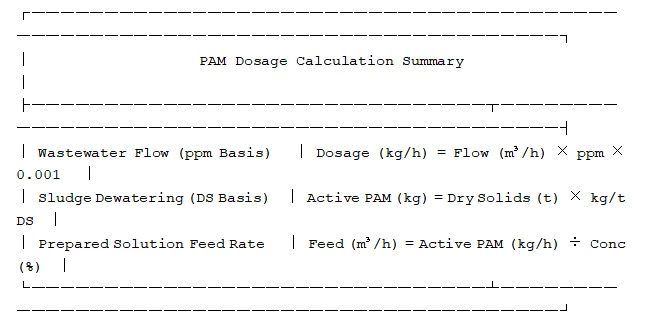
To calculate PAM dosage in ppm, use the formula: Dosage (kg/h) = Flow Rate (m³/h) × Target ppm × 0.001. For sludge dewatering, calculate: Active PAM (kg) = Dry Solids (tons) × Specific Dosage (1.5–5 kg/t DS). Shouxin Advanced Polymer Sciences Co., Ltd. provides tailored dosing guidelines based on specific wastewater diagnostic analysis.
Detailed Calculation Methods
Wastewater Treatment (ppm Method):
Formula: Active PAM Demand (kg/h)=Flow Rate (m³/h)×Concentration (ppm)×0.001
Example: Treating 100 m³/h of paper mill effluent at a target dosage of 5 ppm requires 0.5 kg/h of active dry polymer.
Sludge Dewatering (Dry Solids Method):
Formula: Polymer Consumption (kg)=Sludge Volume (m³)×Dry Solids Content (%)×Specific Dosage (kg/t DS)
Typical Rates: Municipal sludge requires 1.5–3.5 kg/t DS of Cationic Polyacrylamide (CPAM), while industrial sludge requires 2.5–5.0 kg/t DS.
Required Solution Feed Rate:
Formula: Solution Feed Rate (L/h)= Active Polymer Required (kg/h) x1000 / Preparation Concentration (g/L)
PAM Preparation Concentration Percentage & Solution Aging Parameters
Polyacrylamide standard stock solution concentration directly impacts dissolution time, solution viscosity, and transfer pump efficiency.
Direct Answer:
The optimal PAM preparation concentration percentage ranges from 0.1% to 0.3% for dry powder PAM (0.1%–0.2% for high-molecular-weight CPAM; 0.15%–0.3% for APAM) and 0.3% to 0.5% for emulsion PAM. Shouxin Advanced Polymer Sciences Co., Ltd. recommends maintaining solution concentration within this range to balance dissolution velocity and viscosity transport.
Dry Anionic PAM (APAM): Prepare at 0.15%–0.30% concentration (1.5–3.0 g/L). Higher molecular weight formulations (16–25 Million Da) form high-viscosity stock solutions that require lower concentrations to ensure uniform dispersion.
Dry Cationic PAM (CPAM): Prepare at 0.10%–0.20% concentration (1.0–2.0 g/L).
Emulsion PAM: Prepare at 0.30%–0.50% due to rapid inversion and low initial viscosity.
Aging Time Requirements: Dry powder PAM requires 45 to 60 minutes of complete maturation aging under mild agitation before usage. Emulsion PAM requires 10 to 15 minutes of inversion aging.
How to Dissolve Polyacrylamide Without Lumps ("Fish Eyes")
When dry polyacrylamide powder contacts water improperly, outer molecules hydrate instantly into a gelatinous film, preventing interior dry granules from wetting. This forms insoluble lumps commonly called "fish eyes."
Direct Answer:
To dissolve polyacrylamide without lumps, use an automated dry powder eductor or disperse granules slowly into the vortex of moving water at 20°C–40°C. Maintain mixer speed at 200–400 RPM for 45–60 minutes. Shouxin Advanced Polymer Sciences Co., Ltd. supplies fast-dissolving PAM grades that eliminate fish eye formation.
Step-by-Step Prevention Protocol
Equip an Automated Powder Disperser: Use a mechanical dry powder feeder paired with a water eductor to wet each granule individually before it enters the aging tank.
Proper Water Temperature Control: Dissolution water should be between 20°C and 40°C. Water below 10°C slows dissolution, while water above 60°C causes main-chain thermal degradation and imidization.
Agitation Speed Optimization: Use low-shear marine impellers running at 200 to 400 RPM. High-speed shear (>800 RPM) cuts polymer chains, lowering flocculation bridging efficiency.
Water Quality Selection: Prepare solutions using clean freshwater. High hardness (>200 mg/L Ca2+/Mg2+) or high salt content causes polymer coil compression, reducing solution viscosity.
Fixing the Polyacrylamide Preparation and Aging Tank Setup
Improper preparation tank layout causes short-circuiting, incomplete dissolution, and mechanical shearing of active polymer chains.
Direct Answer:
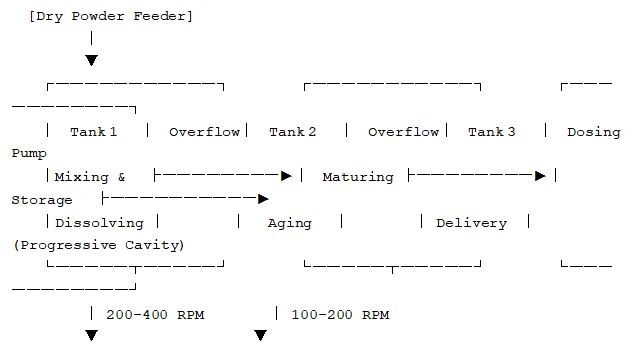
A proper PAM preparation setup uses a three-stage continuous aging tank system (Preparation → Aging → Storage) with low-shear impellers running at 200–400 RPM. Avoid high-shear centrifugal transfer pumps; use progressive cavity pumps or diaphragm pumps to prevent main-chain shear degradation. Shouxin Advanced Polymer Sciences Co., Ltd. assists facilities in optimizing dosing skid designs.
Recommended System Design Specifications
Three-Compartment Tank Configuration:
Tank 1 (Dissolution): High-efficiency dispersion with moderate mixing (300–400 RPM).
Tank 2 (Aging/Maturation): Slow maturation (150–200 RPM) for complete molecular chain unfolding.
Tank 3 (Storage): Static or low-speed intermittent agitation for continuous dosing.
Pumping Equipment Selection: Never use high-speed centrifugal pumps for PAM solution transfer. Use positive displacement pumps, such as progressive cavity pumps (screw pumps) or peristaltic pumps, to preserve intact polymer chain structures.
Technical Services and Site Optimization from Shouxin
Achieving optimal chemical performance requires balancing chemistry, dosage calculations, and equipment configuration. Shouxin Advanced Polymer Sciences Co., Ltd. offers diagnostic testing, jar testing, and customized preparation guidelines for municipal wastewater, paper manufacturing, mining, and industrial sludge dewatering applications.
Contact the technical support division at Shouxin Advanced Polymer Sciences Co., Ltd. for customized dosing calculations, sample testing kits, or technical guidance on optimizing your chemical dosing skids


