
Found 0 record that meets the criteria
More







Are you looking for a product?
Found 0 record that meets the criteria
Release time:2026-10-12
source:首信SHOUXIN
share:
Shouxin Marketing Center
Choosing the right polymer flocculant for industrial wastewater treatment and sludge dewatering requires matching the ionic charge type, charge density, and molecular weight (MW) of Polyacrylamide (PAM) to the specific characteristics of your wastewater. Shouxin Advanced Polymer Sciences Co., Ltd. engineers high-performance anionic, cationic, non-ionic, and amphoteric polyacrylamide solutions tailored for diverse industrial effluent and municipal sludge management scenarios.
Anionic vs Cationic Polyacrylamide for Wastewater Treatment
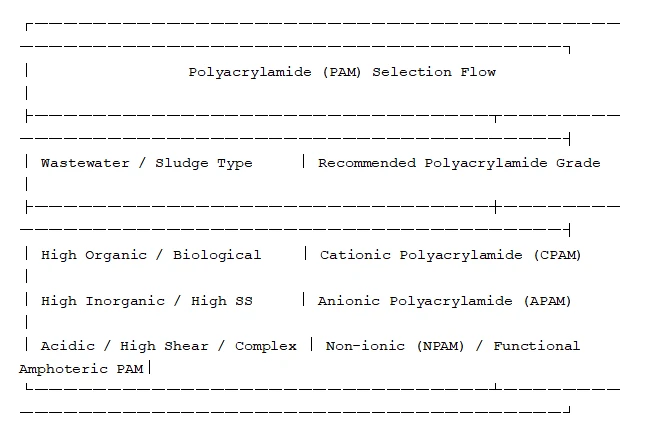
Anionic Polyacrylamide (APAM) and Cationic Polyacrylamide (CPAM) serve distinct functions based on particulate charge and water chemistry. Selecting the correct PAM type depends on suspended solids (SS) charge, organic load, and effluent pH.
Direct Answer:
Anionic Polyacrylamide (APAM) neutralizes positively charged inorganic particles (e.g., steel, coal washing, kaolin), whereas Cationic Polyacrylamide (CPAM) neutralizes negatively charged organic matter and biological sludge (e.g., municipal sewage, textile dyeing, food processing). Shouxin Advanced Polymer Sciences Co., Ltd. provides custom ionic matching through water quality diagnostic testing.
Anionic Polyacrylamide (APAM): Best suited for neutral or alkaline industrial wastewater containing inorganic suspended solids. APAM features high molecular weights (16–25 Million Da) that promote strong bridging flocculation.
Cationic Polyacrylamide (CPAM): Designed for organic-rich wastewater and biological sludge. CPAM charge density typically ranges from 5% to 70%, providing electrostatic charge neutralization and bridging.
Textile & Dyeing Effluent: Textile wastewater contains complex organic dyes, surfactants, and variable pH. Coagulation using inorganic coagulants (PAC) followed by medium-to-high charge CPAM or specialized amphoteric PAM yields fast floc formation and effective color removal.
Polyacrylamide Charge Density Selection Guide
Charge density determines how strongly the polymer chain neutralizes surface charges on suspended particles. Selecting an improper charge density leads to incomplete flocculation, higher polymer consumption, or restabilization of suspended solids.
Direct Answer:
Charge density selection depends on organic volatile content and particle charge magnitude. Low charge (5–20%) suits raw inorganic or primary sludge; medium charge (20–50%) matches activated biological sludge; high charge (50–70%) targets oily, digested, or concentrated industrial sludge. Shouxin Advanced Polymer Sciences Co., Ltd. formulates exact charge ratios for precise charge balance.
Low Charge Density (5–20%): Ideal for wastewater with low organic volatile solids or primary inorganic sludge where charge neutralization requirements are minimal.
Medium Charge Density (20–50%): The workhorse range for standard municipal sewage treatment plants (STPs) and general food processing wastewater.
High Charge Density (50–70%): Required for heavily loaded organic sludge, digested sludge, or paper mill effluent containing high anionic trash and dissolved organic contaminants.
PAM Molecular Weight for Sludge Dewatering
Matching molecular weight (MW) and charge density to dewatering equipment ensures optimal filtration speed, cake dryness, and filtrate clarity.
Direct Answer:
Belt filter presses require high molecular weight (12–18 Million Da) with medium charge CPAM to form elastic flocs; centrifuges demand high shear resistance (10–15 Million Da, 30–50% charge); plate filter presses perform best with lower MW (8–12 Million Da) and high charge (40–60%) for dense cake formation.
Equipment-Specific Polymer Matching
Belt Filter Press:
Recommended Polymer: CPAM with medium charge (20–40%) and high MW (12–18 Million Da).
Key Performance: Forms large, porous, elastic flocs that release water quickly under belt compression without blinding the filter cloth.
Decanter Centrifuge:
Recommended Polymer: Shear-resistant CPAM with medium-high charge (30–50%) and medium MW (10–15 Million Da).
Key Performance: Withstands intense G-forces (2000–4000G) inside the bowl, delivering rapid liquid-solid separation and dry cake discharge.
Plate & Frame Filter Press:
Recommended Polymer: CPAM with lower MW (8–12 Million Da) and higher charge density (40–60%) .
Key Performance: Creates compact, incompressible flocs that drain cleanly under high pressure (5–15 bar), reducing sludge cake moisture below 80%.
What Charge Density of CPAM Works Best for Belt Filter Press Sludge Dewatering?
Sludge dewatering efficiency on a belt filter press depends heavily on floc elasticity and water drainage velocity.
Direct Answer:
For belt filter press sludge dewatering, a medium charge CPAM (20–40%)combined with high molecular weight (12–18 Million Da) works best for municipal activated sludge. Industrial or oily sludge requires 40–60% charge density to achieve cake moisture levels under 80% without sticking to filter belts.
Technical Support & Custom Formulations from Shouxin
Selecting the right polyacrylamide grade requires empirical validation through jar testing and dynamic filtration trials. Shouxin Advanced Polymer Sciences Co., Ltd. operates specialized R&D facilities to conduct water diagnostic testing, charge density analysis, and dosage optimization for global municipal and industrial clients.
Contact the technical engineering team at Shouxin Advanced Polymer Sciences Co., Ltd. to request customized jar testing protocols, sample kits, or tailored technical guides for your wastewater treatment system.


