
Found 0 record that meets the criteria
More







Are you looking for a product?
Found 0 record that meets the criteria
Release time:2026-03-10
source:Shouxin
share:
Shouxin R&D Center
Recently, a research team led by Alessandro Gandin from the University of Padova in Italy published a groundbreaking study in the international top-tier journal Advanced Science. They developed an innovative dynamic polyacrylamide (DPAA) hydrogel that successfully broke the "temporal black box" in traditional mechanobiology research, enabling the first real-time capture of precise hierarchical force signaling within living cells. This study not only revealed the "primary response mechanism" by which cell nuclei sense environmental stiffness but also provided a crucial temporal reference for understanding cellular reprogramming in development, regeneration, and cancer.
Directly Addressing the Pain Point: The "Static" Limitations of Traditional Polyacrylamide
Polyacrylamide (PAA) hydrogels with multiple points of tunability and mature preparation methods have long been the standard platform for studying cell mechanical transduction. However, traditional polyacrylamide gels have a fatal limitation: they are static.
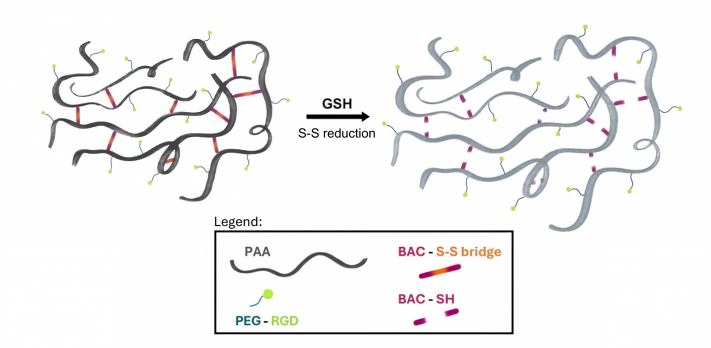
Figure 1: Schematic diagram of the structure of DPAA gel and the process of softening it by adding GSH to degrade the S-S bridge
The current research methods usually require the cells to be digested off the hard substrate and then re-inoculated onto the soft substrate. This process is not only cumbersome but also severely disrupts the original mechanical state of the cells, making it impossible to simulate the progressive mechanical changes (such as tissue fibrosis or tumor growth) that cells undergo in the body. This has led to scientists' long-term difficulty in distinguishing which are the "initial sensors" for mechanical signal transmission and which are the subsequent "adaptive responses" of the cells.
Innovative Strategy: In-situ Softened "Dynamic Polyacrylamide"
To solve this problem, the research team designed a dynamic polyacrylamide (DPAA) hydrogel that can undergo in-situ softening. They introduced disulfide bonds (S-S) crosslinkers into the gel network and used the cell-impermeable reducing agent glutathione (GSH) as the "switch". By adding GSH to the culture medium, the researchers could precisely control the gradual transition of the substrate from "hard" (12 kPa) to "soft" (1.2 kPa) while maintaining the continuous adhesion of the cells, thereby simulating the real mechanical microenvironment remodeling process in the body.
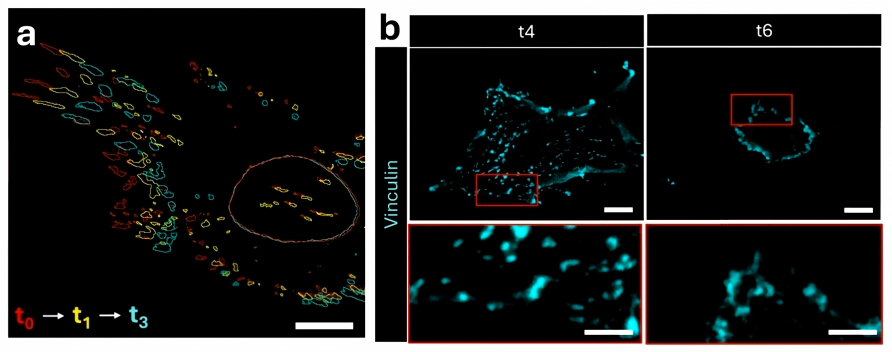
Figure 2: (a) Static images of film S2 (cells were inoculated onto a gel with an initial stiffness of approximately 12 kPa, allowing them to adhere to the surface of the hydrogel overnight, and imaging was performed during the gel softening process); (b) Representative images of WI38 cells inoculated onto a 12 kPa DPAA gel, captured during the second stage of gel softening (t4-t6)
Amazing discovery: The "dual-phase" timeline of YAP/TAZ inactivation
By utilizing this dynamic polyacrylamide platform in conjunction with live-cell imaging, the research team observed astonishing details of the cells' response to the softening of the substrate:
1. First stage (early response): When the substrate begins to soften, the focal adhesions around the cells (Peripheral Focal Adhesions) do not immediately disintegrate. Instead, they exhibit remarkable resilience and maintain the cell's attachment and tension through centripetal remodeling.
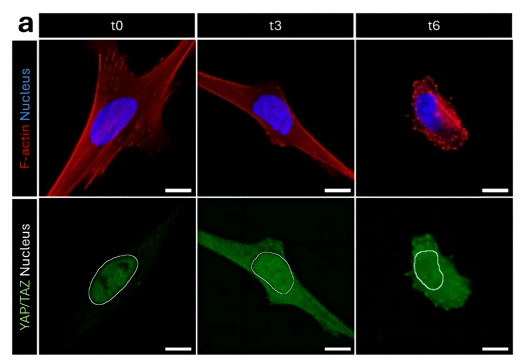
Figure 3: (a) Representative immunofluorescence images of WI38 cells seeded on 12 kPa DPAA gel, fixed at different time points (t0, t3, t6) during the gradual softening process of the dynamic gel
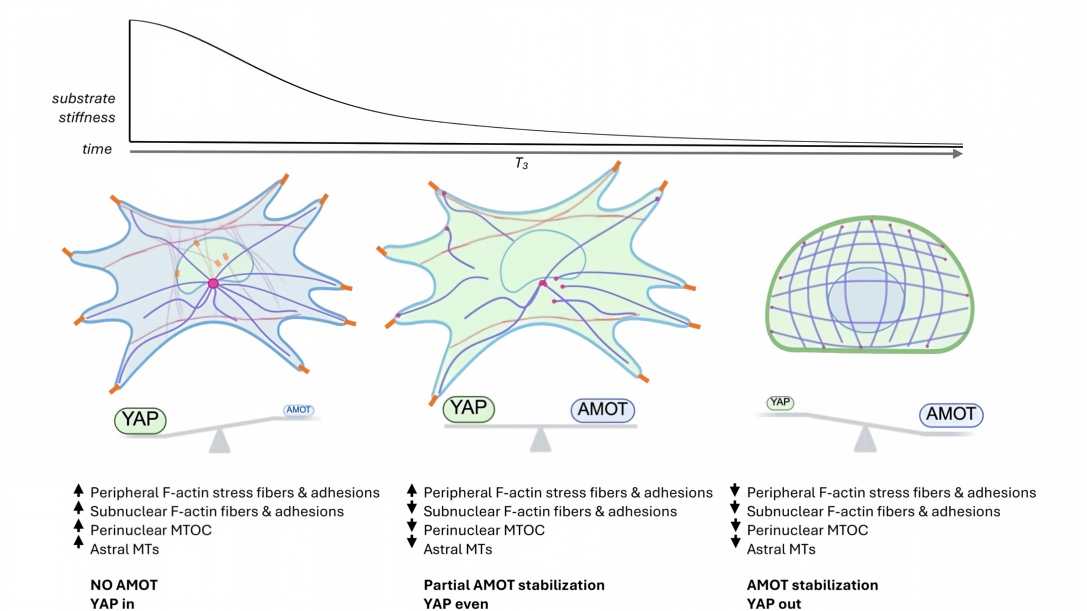
Figure 4: Schematic diagram of the biphasic mechanical response of cells to matrix softening
2. Key threshold (t3 time point): The study revealed that the critical nodes of mechanical transduction are concentrated in the approximately 60-minute time window (t3) following the onset of basal softening.
◦ Subcellular structure: Unlike the peripheral adhesion plaques, the "subnuclear adhesions" that connect the cell nucleus to the cytoskeleton and the associated F-actin fibers rapidly disintegrate at this moment.
◦ Signal transduction: Almost simultaneously, the mechanical core transcription factors YAP/TAZ rapidly translocate from the nucleus to the cytoplasm, marking the "closure" of the mechanical signal transduction process.
◦ Microtubule reorganization: At the same time, the microtubule organizing center (MTOC) disassembles from its position around the cell nucleus, accompanied by the rapid accumulation of the inhibitory factor AMOT for YAP/TAZ.
Core conclusion: Nuclear membrane tension is the "first sensor"
This study utilized the precise time axis provided by dynamic polyacrylamide to establish the hierarchical sequence of mechanical signal transduction: the disruption of the sub-nuclear adhesion plaques/ nuclear skeleton connection was the initiating event for the inactivation of YAP/TAZ, while the overall changes in cell morphology, the alteration of nuclear shape, and the eventual collapse of the surrounding adhesion plaques occurred later as a subsequent adaptive response.
In short, the cell nucleus perceives the pulling mechanism through "nuclear pores", which is faster and more crucial than through "cell shape".
Future Outlook: The Asymmetric "Mechanical Ratchet" Effect
This study also revealed the "ratchet" effect of mechanical response - when cells transition from a "soft" environment to a "hard" one, merely applying static tension is not sufficient; only cyclic stretching can efficiently activate YAP/TAZ. This discovery suggests that cells may determine their fate in the body by "accumulating" mechanical stimuli.
This work not only revolutionized the application paradigm of multi-point polyacrylamide hydrogels, upgrading from "static scaffolds" to "dynamic stimulators", but also provided precise molecular targets and time windows for the development of new therapies targeting cancer (especially metastasis) and tissue fibrosis.
Source:Advanced Science
Original Title:Timing Mechanotransduction: Mechanically Dynamic Biomaterials Reveal the Temporal Hierarchy of YAP/TAZ Control Nodes
Original Author:Alessandro Gandin et al.


